To check public spending on a road, identify the exact work first. A road name can cover several stretches, contracts or years. Once you have the responsible agency and work identifier, look separately for the amount sanctioned, the payment recorded and the physical progress reported. Each answers a different question.
Start at the road, then find the record
Write down the district, nearby settlements, start and end landmarks, and the text on any project board. Photograph the board if you can do so safely. Look for the implementing agency and the work or package number. Keep the spelling from the board even if residents use another name. A package may cover several roads, so also record the length and endpoints of the specific stretch.
For a Pradhan Mantri Gram Sadak Yojana (PMGSY) road, the National Rural Infrastructure Development Agency describes local-language citizen information boards and directs residents to the programme’s monitoring system. Start with its official programme FAQ and online monitoring system. For a municipal street, identify the municipality or other named authority and find its works records. A street outside PMGSY may have no entry in the rural roads system.
Read the figures together
| Record | What it tells a resident |
|---|---|
| Sanction of ₹20 lakh | The approved amount for the described scope. Check its date, length and any revisions. |
| Payment entry of ₹8 lakh | The amount shown in this entry. Check whether it is one instalment or the cumulative total, and which work it covers. |
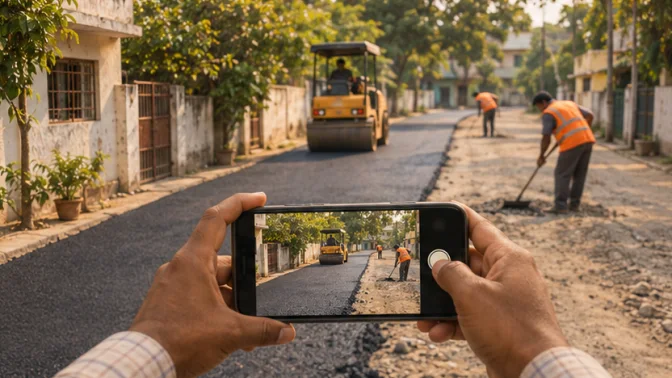
| Photo of 250 metres of asphalt | A view of one stretch at one time. Look for the location, date, direction of view and adjoining unfinished stretch. |
Here ₹8 lakh is 40% of ₹20 lakh. It would be a mistake to label the road “40% complete” from that calculation. A contract may have different rates for excavation, drainage and surfacing. Payment and inspection dates can also differ. Even the apparent gap of ₹12 lakh cannot be described as missing money on these figures alone.
Ask a question someone can answer
“Where did the money go?” is hard to resolve from a single photo. A more useful request would identify the package and ask which bill the ₹8 lakh entry relates to, what length that bill covers, and the date of the associated measurement or inspection. If the portal shows a cumulative figure, ask for the period it covers. Record the date you looked up each figure so later updates can be compared fairly.
When documenting a site, use a fixed landmark such as a culvert or junction, note the direction of view and consider taking a second image from the same point on a later date. Keep unnecessary personal details out of a public report. For PMGSY feedback, NRIDA describes the Meri Sadak service and the use of georeferenced photographs. NRIDA annual report, section 2.9.7.
Where a public ledger fits
The second phase of the NyayLedger pitch proposes linking a sanction, contractor payments and dated site reports through verifiable receipts. A resident could check that a published payment record matches the version that was timestamped. If the question is whether the drain was built to specification, the next useful record is a measurement or inspection. Blockchain verification and a site visit answer different parts of the same public question.